humansays
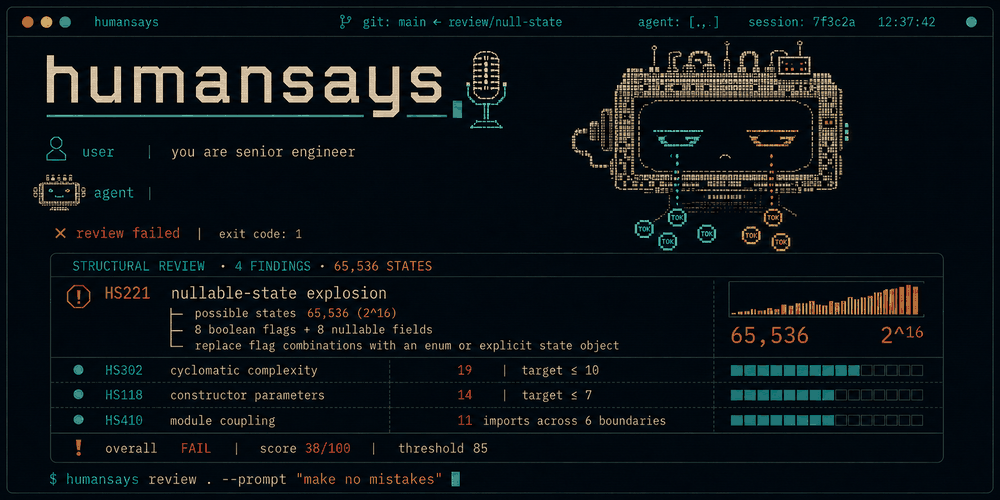




A python linter which evaluates how difficult AI generated code is to read, understand, test, maintain, and safely modify. It gives coding agents actionable and easy to reason about feedback on design problems that traditional linters, type checkers, and tests cannot detect.
!!! warning "Early development"
This is 0.1.0a1. The rule identifiers, the configuration schema, and
the JSON output shape will change before 0.1.0. Do not pin automation
to HS### codes yet.
Install
There are no runtime dependencies and no extras. The package is on PyPI as
humansays and needs Python 3.11 or
newer.
Run it
Point it at a file or a directory.
files=5 lines=335 targets=6 errors=0
score 83.6 (B) penalty 4.92 over 335 lines density 1.469/100 lines
src/humansays/reporting/ansi.py:29-36 use_color boolean-modes
src/humansays/reporting/ansi.py:39-44 _style boolean-modes
src/humansays/reporting/ansi.py:47-59 indicator_text boolean-modes
src/humansays/reporting/ansi.py:62-73 score_text boolean-modes
src/humansays/reporting/ansi.py:76-112 report_lines boolean-modes
src/humansays/reporting/render.py:43-50 report_text boolean-modes
Each line is a location, a symbol, and the signals that fired against it. Output and scoring explains the score, the grade, and the JSON shape.
What it looks at
A linter checks whether a line is written correctly. A type checker checks whether values fit together. Neither has an opinion about whether a function has quietly accumulated four jobs. That gap is what this tool reports on, and it reports on four things in particular.
How many jobs a unit has taken on. Argument count, branch count, nesting depth, and body length are each weak on their own. Together they describe a function that grew past what one name can honestly describe. See Function shape.
Who is allowed to mutate a piece of state. Module-level mutable bindings and attributes written from several different methods both mean the same thing: no single place owns the value, so no single place can be held responsible when it is wrong. See State and boundaries.
Which side effects a unit reaches. A function that touches the filesystem, the network, a database, and a subprocess cannot be tested without standing all four up. The tool counts the standard-library boundaries a body reaches and reports when they pile up in one place. See State and boundaries.
How much a reader has to hold in their head. Attribute count, base class count, and how many of a class's methods actually touch its own state all measure the same thing from different angles: the cost of understanding one piece without reading the rest. See Class design.
How a finding is framed
A finding is a location, a weighted score, and a review question. It is not a verdict, and the tool does not tell you what to do.
Every rule in src/humansays/catalog.py carries a review_question field,
and that question is the point of the rule. For HS001, too many arguments:
Do these values form a request object, reusable configuration, or multiple responsibilities?
For HS004, shared mutable state:
Is the lifetime intentional, who owns mutation, and can tests isolate this state?
All three answers to the first question are legitimate. The rule cannot tell which one applies, and it does not try to. It marks the spot and names the question a reviewer should be asking there.
What it cannot do
Three limits are worth stating plainly, because they bound everything above.
Syntax cannot prove intent. A function with eight arguments may be exactly right for its job. The tool reports the shape, not a defect.
Syntax cannot prove runtime effects. Reaching a subprocess import in a body
is evidence that the function may run a process, not proof that it does.
Syntax cannot prove authorship. Nothing here detects whether a model wrote the code. It detects structure, and structure is the same whoever produced it.
This is not a replacement for a type checker, and it is not a general linter. Run it alongside those, not instead of them.
Where to go next
- Getting started, installing it and reading the first run
- Configuration, every key and its default
- CLI, every flag
- Rules, all 19 shipped rules with what triggers each one
- Design philosophy, the model of working code the rules encode